Survey of 574 finance professionals examines emerging technologies and the changing role of management accounting
As artificial intelligence, big data, cloud computing and blockchain develop, corporate finance functions face new opportunities and challenges. How will these technologies affect the way finance professionals work, and what roles will management accountants play?
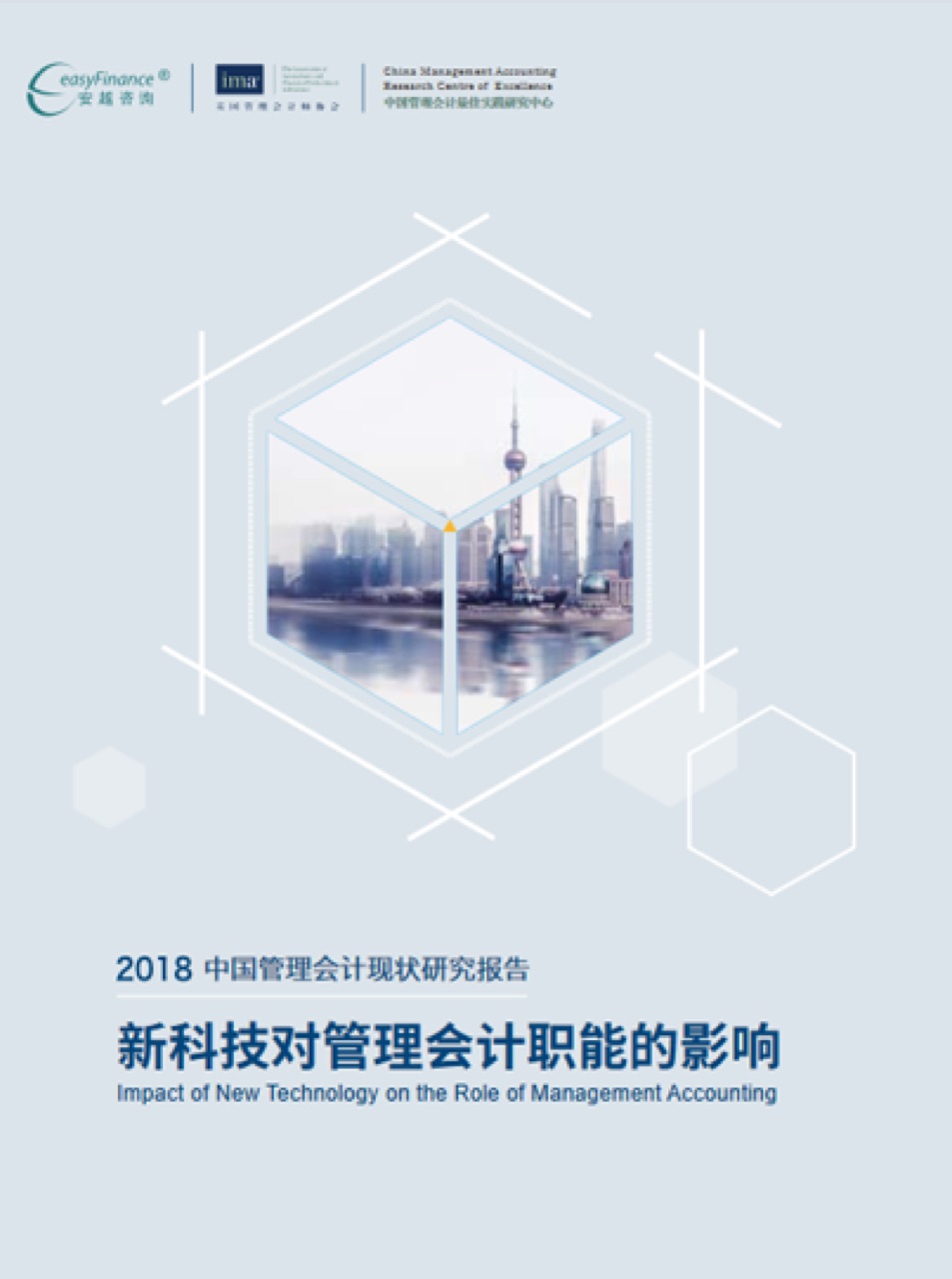
In 2018, Shanghai EasyFinance Enterprise Management Consulting Co., Ltd. (EasyFinance) and the Institute of Management Accountants (IMA), through the China Management Accounting Research Center of Excellence established jointly by the two organizations, conducted a study entitled Impact of New Technology on the Role of Management Accounting: 2018 China Management Accounting Survey.
The study gathered 574 valid responses in January and February 2018. It examined management accounting practices in Chinese enterprises, professional capabilities and the potential impact of emerging technologies on finance functions.
574 valid responses provide a view of management accounting practice
As businesses grow and their operations become more complex, finance teams are being asked to go beyond accounting, reporting, oversight and control. Budgeting, cost management, business analysis, risk management and decision support are becoming increasingly important.

The joint survey sought feedback from finance professionals across companies of different industries, ownership structures and sizes. It explored existing management accounting practices, professional skills and changing expectations for finance functions.
The study aims to identify practical challenges and the capabilities finance professionals may need to strengthen as business requirements and technologies evolve.
Emerging technologies raise new professional capability requirements
Technology was a major theme of the research. Survey topics included artificial intelligence, blockchain, business analytics, data analytics, data architecture, data integration, data security, data warehousing and business intelligence.
These technologies may enable companies to process information more efficiently, improve the quality of business analysis and support management decisions. Analytics and business intelligence tools can help finance teams consolidate information and recognize changes in operating performance, while automation can reduce some repetitive tasks.
At the same time, finance professionals need more than technical familiarity. They must understand business activities, connect operational drivers to financial outcomes and translate analysis into recommendations. Digital finance development also involves process design, management practices and organizational skills.
From stewards and operators to strategists and catalysts
Another important subject was the changing role of finance professionals. The research highlighted their ambition to expand beyond the traditional roles of steward and operator toward those of strategist and catalyst, taking a more active role in strategy, business improvement and organizational change.
The stewardship role remains essential for risk management and compliance, while the operator role supports day-to-day business needs. The strategist and catalyst roles call for broader commercial understanding, strategic participation, collaboration across departments and the ability to advance change.
Emerging technologies can help create the conditions for these broader responsibilities, while increasing the need for professional judgment and change-management skills.
EasyFinance and IMA focus on professional development
EasyFinance and IMA have cooperated on management accounting education and research in China. In 2013, they jointly established the China Management Accounting Research Center of Excellence to study management accounting practices and connect international professional methods with the needs of Chinese enterprises.
In the context of the joint research and related professional exchanges, EasyFinance General Manager Marshall Ma emphasized the need for both finance professionals and management teams to adapt their thinking and engage with new technologies. In addition to planning, budgeting, forecasting, risk management, internal control and decision analysis, finance professionals need stronger strategic thinking, execution, process-development and finance-transformation capabilities.

Progress in the finance function requires both technology adoption and the development of professional skills.
Research offers a reference point for finance transformation
The shift from financial reporting toward business support and strategic participation is continuing. Emerging technologies can strengthen finance management and decision-making, but they also require organizations to reconsider responsibilities and skills.
Based on 574 valid survey responses, the 2018 research report presents evidence on management accounting practices and finance professionals’ views of new technologies and changing roles.
Through continued joint research, EasyFinance and IMA seek to promote the practical application of management accounting and support finance capability development in Chinese enterprises.
Easy Finance has supported management accounting, strategic finance and enterprise AI capability building since 2004.
Learn more: www.easyfinance.com.cn/en